Canadian Rail Operating Rules (CROR) Explained
Updated August 4, 2026 · Canadian Railway Solutions Corp.
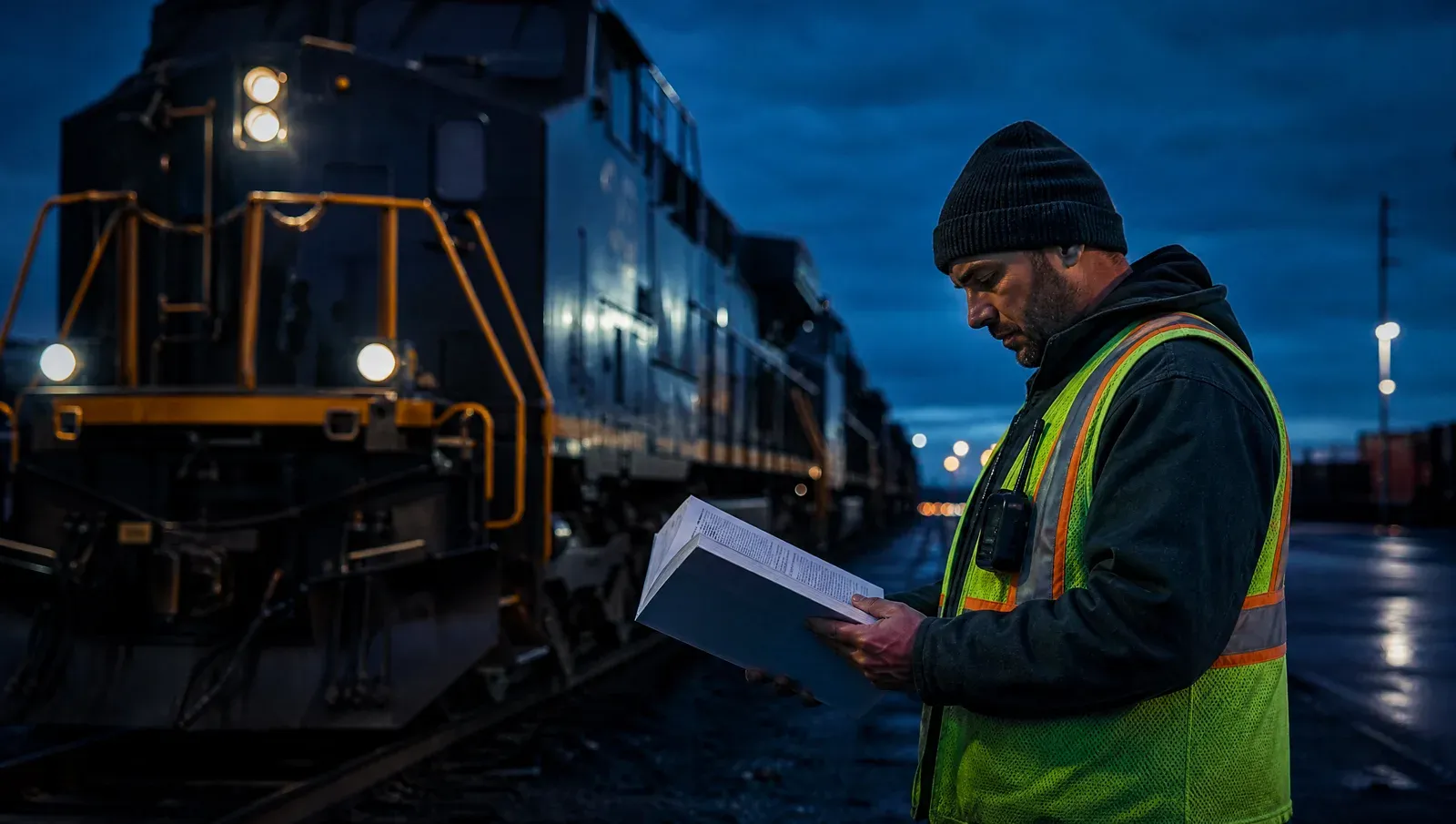
Every train movement on a federally regulated railway in Canada, from a transcontinental freight to a single locomotive shuffling cars in a yard, is governed by the same rulebook: the Canadian Rail Operating Rules. This guide explains what the CROR is, who must follow it, what the rules cover, how the CROR differs from the Industrial Rail Operating Rules (IROR), and how railway workers become and remain CROR certified.
What Are the Canadian Rail Operating Rules?
The Canadian Rail Operating Rules (CROR) are the national operating rulebook for Canada's federally regulated railways. Developed by the railway industry and approved by the Minister of Transport under the Railway Safety Act, the CROR governs train and engine movements, signal indications, switches, track occupancy authorities, speeds, and emergency procedures on every railway under federal jurisdiction.
The CROR replaced the Uniform Code of Operating Rules (UCOR) in 1990 and has been revised many times since. Rules are drafted and updated by the railway industry, then filed with and approved by the Minister of Transport under the Railway Safety Act. Transport Canada publishes the current rules and amendments on tc.canada.ca.
It is important to understand that the CROR is a minimum standard. Individual railways layer their own timetables, special instructions, and General Operating Instructions (GOI) on top of the rules. Those documents can be more restrictive than the CROR, but never less, which is why rules training always pairs the rulebook itself with the specific instructions in force on the territory where a crew works.
Who Must Comply With CROR?
CROR compliance is mandatory for federally regulated railway companies and for local railway companies operating on federally regulated track. That includes locomotive engineers, conductors, yard crews, rail traffic controllers, and track forces: anyone whose duties are governed by the rules. Provincially regulated and industrial railways are not automatically bound by CROR, but many adopt it or a variant through provincial regulation or company policy.
In practice, the obligation follows the work, not the job title. If your duties involve operating movements, handling switches, protecting track work, or fouling track on a railway that runs under the CROR, you need a current rules qualification. Employers are responsible for ensuring that employees in safety-critical positions are properly trained and examined, and host railways typically extend the same expectation to contractors and industrial customers whose people work on or beside their trackage.
The examination requirement is worth flagging separately: it is not enough to have taken a course at some point. Employees must have passed an examination on the rules that apply to their duties, and that qualification must still be within its validity period on the day they perform the work. Expired qualifications are treated as no qualification at all.
What Does CROR Cover?
The CROR covers the full range of operating situations on a railway: general safety and employee-fitness rules, fixed and hand signal indications, switches and derails, the methods used to authorize track occupancy, such as Occupancy Control System (OCS) and Centralized Traffic Control (CTC), the protection of track work and track units, movement speeds, and emergency procedures.
- General rules: the foundation rules every employee must know, including fitness for duty and the prohibition on intoxicants.
- Signals: fixed signal indications, hand and radio signals, and the actions each one requires.
- Switches and derails: how they are lined, locked, and verified before and after movements.
- Track occupancy authorities: the permission systems that keep movements separated, including OCS clearances and CTC signal authority.
- Protection of track work: planned protection for maintenance forces and track units, including Rule 42 protection.
- Emergency procedures: what crews must do when a movement is stopped in emergency, equipment is left on a main track, or protection must be provided against other trains.
Because the rules interlock (a signal indication only means something in the context of the method of control in effect), CROR training is taught as a system rather than a list. Crews are examined on how the rules apply together in realistic operating scenarios, not just on definitions.
What Is the Difference Between CROR and IROR?
The CROR applies to federally regulated railway operations, while the Industrial Rail Operating Rules (IROR) are written for industrial trackage: plant sites, terminals, and private spurs where cars are switched at low speed by the facility's own crews. IROR distills the operating principles of the CROR into a framework suited to industrial operations that fall outside federal jurisdiction.
Which rulebook applies is ultimately a question of jurisdiction and operation. An industrial facility switching its own cars on private trackage inside the fence is generally not a federally regulated railway, so the CROR does not automatically apply, but the hazards of moving rail equipment do not change, which is why IROR exists. Facilities that interchange with a federal carrier should pay particular attention to where one framework ends and the other begins, because the interchange track is exactly where responsibilities tend to blur. Our team trains crews under both rulebooks through our railway safety training programs.
How Do You Get CROR Certified?
CROR certification is earned by completing rules training and passing an examination delivered by a qualified instructor or training provider. Certification is not permanent: operating employees must requalify periodically (commonly on a three-year cycle), and employers are responsible for ensuring that every employee governed by the rules holds a valid, current qualification.
An initial CROR course walks candidates through the rulebook section by section, ties each rule to the special instructions in force where they will work, and finishes with a formal examination. Requalification courses refresh that knowledge, capture rule amendments issued since the last cycle, and re-examine the employee. Employers should keep dated records of every qualification, because training records are among the first documents reviewed in a rail safety audit or after an occurrence.
Canadian Railway Solutions Corp. delivers CROR and IROR training on-site anywhere in Canada, tailored to your operation and your special instructions. See our rail safety training services for program details.
How Often Does the CROR Change?
The CROR is a living document. Amendments are developed by the railway industry and approved by the Minister of Transport under the Railway Safety Act, and revised editions are issued periodically. Between editions, railways communicate changes through bulletins and special instructions, and every operating employee is responsible for working from the current version of the rules.
For safety managers, this creates a housekeeping obligation that is easy to underestimate. Printed rulebooks in lunchrooms and locomotive cabs drift out of date, requalification training must reflect the edition actually in force, and internal documents that quote rule numbers need to be rechecked whenever an amendment lands. A simple document-control routine (one owner, one current master copy, a dated distribution record) is usually all it takes to stay ahead of the problem, and it is exactly what an auditor will ask to see.
Where Can You Download the Official Rules?
You can download the consolidated Canadian Rail Operating Rules and the Industrial Rail Operating Rules below, and Transport Canada publishes rules and amendments on tc.canada.ca. Keep a current copy accessible to every operating employee. Working from an outdated rulebook is one of the most common findings in rail safety audits.
Canadian Rail Operating Rules (CROR)
Download the CROR rulebook (PDF)
Industrial Rail Operating Rules (IROR)
Download IROR Schedule 1 (PDF)
Need CROR or IROR Training for Your Crew?
We deliver initial certification and requalification training on-site anywhere in Canada, built around your trackage, your equipment, and your special instructions.
Explore Rail Safety Training