What Happens After a Train Derailment in Canada?
Updated August 4, 2026 · Canadian Railway Solutions Corp.
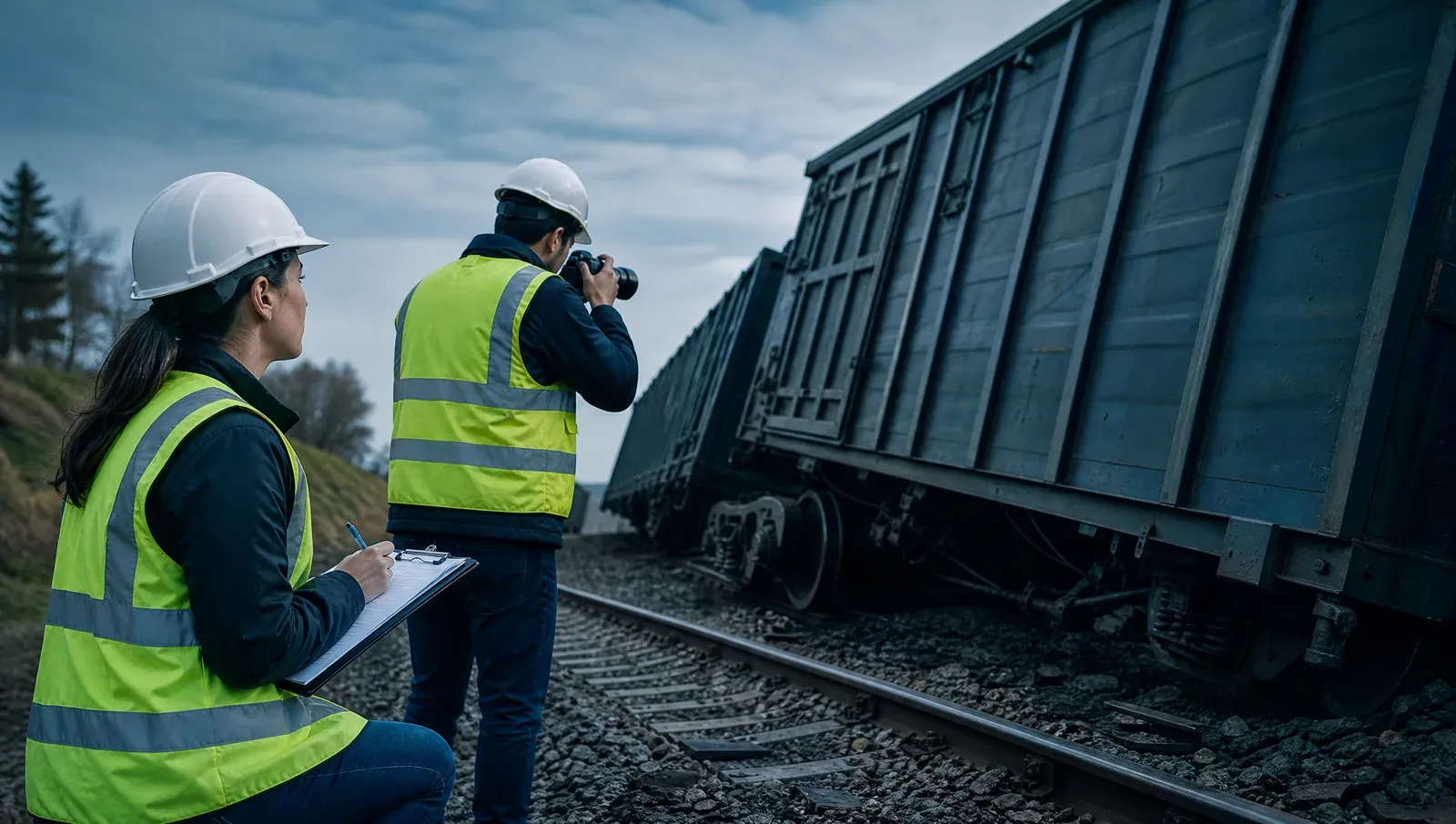
A derailment is the moment every rail operator plans never to have, and the moment when preparation shows. What happens in the hours and weeks that follow determines whether the true cause is found, whether it can happen again, and how the operator stands with regulators, insurers, and connecting carriers. Here is how derailment investigations actually work in Canada, from the first phone call to the corrective action plan. The process differs depending on whether the track is federally regulated or industrial, so this guide covers both.
Who Investigates Train Derailments in Canada?
The Transportation Safety Board of Canada (TSB) investigates reportable railway occurrences (including derailments) on federally regulated railways, under the Canadian Transportation Accident Investigation and Safety Board Act. The TSB's mandate is to advance safety, not to assign blame. Derailments on industrial or provincially regulated trackage are typically investigated by the operator, often supported by independent rail safety specialists.
The TSB is independent of Transport Canada, and its governing statute is published at laws-lois.justice.gc.ca. Occurrences on federally regulated railways must be reported to the TSB, which then decides whether and how deeply to investigate. Other parties can be involved in parallel: Transport Canada may inspect for compliance with the Railway Safety Act, police attend where there are injuries or fatalities, and provincial occupational health and safety authorities have jurisdiction over worker safety. For an industrial operator, an independent investigator provides the objectivity that regulators, insurers, and connecting carriers expect.
What Must Be Reported After a Derailment?
Reporting obligations depend on where the derailment happens. Occurrences on federally regulated railways must be reported to the Transportation Safety Board under its reporting regulations. Where workers are injured, provincial occupational health and safety authorities must also be notified, and dangerous goods releases trigger their own reporting. Industrial operators should confirm their reporting duties before an incident, not after.
Contracts add another layer: interchange agreements and lease arrangements with serving carriers commonly require prompt notification of any derailment on or affecting shared trackage, and insurers expect timely notice as a condition of coverage. The safest approach is a one-page reporting matrix in your emergency plan (who gets called, by whom, within what time, with which details), reviewed annually and kept beside the phone list.
What Happens Immediately After a Derailment?
In the first hours after a derailment, the priorities are life safety, site securement, and evidence preservation. The area is protected against other movements, emergency responders deal with injuries and any dangerous goods, the occurrence is reported to the required authorities, and the site is documented (photographs, measurements, event recorder data, and witness statements) before anything is moved.
The hardest part of this phase is resisting the pressure to restore service. Wheel marks on the rail, the position of derailed equipment, broken components, and track panel displacement are all perishable evidence: once the wreck crane starts working, they are gone. A disciplined operator secures the site, assigns someone to photograph and measure systematically, preserves failed components with a documented chain of custody, and downloads locomotive event recorder data before power is moved. Those first-day decisions decide whether a root cause can ever be established with confidence.
A minimum first-day evidence list looks like this:
- Site photographs: wide, mid, and close-up, with a scale reference in frame.
- The point of derailment, located and measured before equipment is disturbed.
- Positions of equipment, switches, and derails exactly as found.
- Event recorder downloads before locomotives are moved or released.
- Crew and witness statements taken the same day, while memories are fresh.
- Failed components preserved, tagged, and stored with a documented chain of custody.
How Is the Root Cause of a Derailment Determined?
Root cause analysis works backward from the point of derailment. Investigators examine track condition and geometry, the mechanical condition of the equipment, how the movement was handled, and the environment at the time. Physical evidence (wheel flange marks, rail breaks, failed components) is matched against inspection and maintenance records and, where needed, laboratory metallurgical testing, to establish the sequence of events.
Causes generally fall into four families, and a thorough investigation tests all of them rather than stopping at the first plausible one:
- Track: gauge widening, alignment and surface defects, tie and fastener condition, rail defects, and switch or frog wear.
- Equipment: wheel and bearing failures, suspension and truck defects, brake system faults, and load shifts.
- Operations and human factors: speed, train handling, securement, rules compliance, training, and fatigue.
- Environment: washouts, extreme temperature effects on rail, visibility, and contamination in flangeways.
Most derailments have more than one contributing factor, and the finding that matters most is usually the systemic one: why the defect existed, why it was not caught, and what gap in the safety management system allowed both. That is why a credible investigation ends with corrective actions aimed at the management system, not just a repaired track panel. Fixing the defect without fixing the process that missed it simply schedules the next occurrence.
How Long Does a Derailment Investigation Take?
There is no fixed timeline. A straightforward, low-consequence derailment on industrial trackage can often be investigated in a matter of weeks, while complex TSB investigations involving main-track derailments, dangerous goods, or fatalities can take a year or more before a final report is published. Scope, laboratory testing, and the number of parties involved all drive the schedule.
The TSB scales the depth of its investigations to the safety value of the occurrence, and publishes its findings and recommendations publicly. Operators should not wait for a final report to act: where an obvious hazard is identified early (a defective switch, a failed bearing lot, an untrained crew), interim corrective action should be taken immediately and documented. A good investigation report separates what must be fixed now from what should change in the program. Communicating that split early matters, because operations wants a reopening date, and a clear interim-actions memo is usually what unlocks it safely.
How Do You Prevent Derailments?
Most derailments are preventable. Prevention rests on disciplined track inspection and maintenance, sound equipment condition, competent and current operator training, and a safety management system that actually identifies and corrects hazards before they become failures. Regular independent audits close the loop by testing whether all of those defences are working in practice.
On the infrastructure side, that means inspecting track to the standards that apply to your operation and actually closing out the defects found; our track inspection service covers both. For federally regulated operations the benchmark is the Rules Respecting Track Safety approved under the Railway Safety Act; industrial operators should adopt an equivalent written standard so inspections are measured against something concrete. On the people side, it means crews trained and requalified under the applicable rulebook through structured rail safety training. And on the system side, a periodic industrial rail audit verifies that inspections, maintenance, and training are happening the way your program says they are, before an investigator has to ask why they were not.
Had a Derailment, or Determined Not to Have One?
We conduct independent derailment investigations for industrial rail operators across Canada, and the track inspections that keep you off the occurrence list in the first place.